Friday, October 28, 2011

E-Business!

I have always been curious about E Business and how it works, it seems so easy to just make money nowadays. Just set up an online shop (with no worries about rent or needing people to man the shop), sell a product and TADAH! Money keeps pouring in... But is it really that easy?

I have seen all the online blogshops and its presence in Singapore. So how do you start setting up an E Business? Here's some tips I got from various websites!

1. Find out what you want to sell. Choose something you really could market and love.

2. Join several social networks and begin building relationships. Find friends that you feel you could join our network. i.e. don't sell gym equipment to the elderly. Find relevant networks.

3. Find out the structure of your business. If you have a partner, or work alone. What permits or laws you need to follow or abide

4. Choose a decent and relevant name. It is essential for your business to grow.

5. Put your plan on paper. Unless you're looking for financing, you may not need a formal business plan. Find out your missions, your target market is and how you will let them know about your business. Count the cost.

6. Build a website. Even free hosting ones may surprise you.

7. Formally launch your businesses. Find good relevant contacts and tell them how excited you are.


Monday, September 19, 2011

Week 3

Did you know about the new Google Plus? Did you know it reached 10 millon users just after two weeks?! I'm sure you already know the new features, but let me tell you some of them and the many cool applications Google already has and trying to weave them together.

"Circles" - Your friends are now segregated into the circle you assign them to, no worries that your party photos will end up on your bosses Newsfeed now!

"Hangout" - This is a group webchat function where friends of your 'circle' can come together and hangout. It looks definitely much better than Facebook group chat.

Other applications Google has?


Google Maps is something I use all the time. It is a feature that enables you to get directions to where you want to go or just check the place out. It even gives you a street view, allowing users to search and find the place easily and look for what's available nearby and how to get there via public transport, private transport or walking. It is amazing how Google manages to get such comprehensive coverage on areas around the world, not just Singapore.


Google trends gives you information on whats 'trending' now based on your location and time frame. So if you want to see what everybody is searching for and cash in on the latest trend, this is your tool. One good feature in Google Trends is that it brings you news results, which might be useful in helping you to gain more insights about your search.

Google is sure to be the top few competitors in the market with this many applications (though many of its apps failed to take off too). Only time will tell if Google+ overtakes Facebook.

Thursday, September 1, 2011

Wk 2

Week 1

It is interesting to see how the internet is now being intertwined with our daily lives. A vast difference from the yesteryear, from my old mobile phone, we now have the Android phones or the iPhone to surf the web, make purchases, view YouTube on the go. It is exciting to see what the future of the internet contains. So how did it all start?


Web 1.0

Web 1.0 is a platform of information that is read only. It was static and non-interactive web pages that at most allow for an interchange of documents. In 1996 for were 45 million global users. The focus of Web 1.0 was on companies and owning content. You basically could not do anything else but browse like a book.

Web 1.0 was used for Geocities, Hotmail, home pages, Netscape, Britannica Online...

Web 2.0

With the evolution of the internet, some people define Web 2.0 as a platform for participation, a focus on communities, sharing content or user-generated content, and an interchange of data. The focus of Web 2.0 was on web applications. People recommending each other videos, sites, pages drove the success of Web 2.0. Over 1 billion people were using Web 2.0 in 2006.

Examples of Web 2.0 use include Flickr, YouTube, Digg, read-write Web, blogs, Wikipedia, RSS (Really Simple Syndication)...

With the dynamism and constant evolution of the internet, people predict we are entering Web 3.0. Where computers are able to make sense of data (semantic web), virutal worlds can be incorporated and used for information services and libararies. Of course, the increased power of broadband and streaming capabilities. It is scary to think that computers will be able to run on their own without the use of human input; able to give meaning to things and form their own solutions. However, the potential is limitless. The use for it to find solutions is tremendous. The computer will be able to generate for you solutions for medical illness.

At the same time, it makes me wonder what happens to those left behind in this internet revolution? Whose lives are better off?


Nevertheless, it is still exciting to be living in the time where we can see it all happening.

Tuesday, June 7, 2011

COM125 Wk 1

Week 2


We all know the social networking site - Facebook. And we all know how it took over sites like My Space and Friendster. But what really drives this need to be socially connected? Quoting from the Facebook movie, "The Social Network", are we all really just Farm Animals?


Facebook is so widespread and pervasive that, quoting, “Bosnia. They don't have roads, but they have Facebook”. It is also interesting that the most popular social networking site was created by a (as the movie depicted) socially inept drunk teenager. The beginnings of Facebook was Facemash and operated on the basis of Facebook was the same old college scheme which was to ‘hook up’. It strucks me how recent Facebook was created and we are experiencing firsthand the changes and effects of this new ‘technology’ that has entirely changed the way we view our world, Marshall McLuhan’s Global Village (A communication theory in COM101).


The question that bothers me is the purpose of Facebook (or twitter); other than for sharing information and ‘keeping in touch’, I believe, lies a desperate need for acceptance and identity. We find out who people are even before we meet them personally. We put selected parts or all our lives up online to create interest in others or be ‘liked’. We are now our own celebrities. We find comfort in strangers and in the phrase, ‘misery finds company’. I feel we are on the verge of decadence. However, I find myself unable to delete my Facebook, its almost mystical. Twitter is also another social networking arm, fantastic for business and hearing the first-hand news (including the latest breakups/gossips) but do you really want your conversation broadcasted to the world? But then again, who really wants to listen to you.


As the old saying goes, careful what you upload. Privacy laws are already being fought. Ryan giggs found himself in a hot mess on Twitter. Can anything really be private?


Sunday, March 15, 2009

Omega Ωω

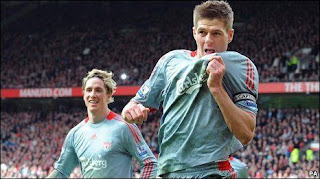
Manchester Utd 1 : Liverpool 4

As many of you might have heard, Liverpool won Manchester United 4-1. :( It was a highly entertaining match with many funny happenings, for example TEVEZ trying to hard to push the ball in. Overall, i think it showed how much a player means to a team. The chain is only as strong as its weakest link.

I was humourously reminded, of cultural imperialism. "Eh, dun watch already la, Man utd playing like S-league leh!", said one of my friends.

What is cultural imperialism? In lay-man terms, in the domination of a foreign culture. For example, the typical example, Macdonalds. It has dominated the world; You surely would be able to find a Macdonald store anywhere you go.

So how does soccer relate to cultural imperialism? The English Premier League.

Our local league, The S-league does not impress us. We find ourselves supporting ENGLISH clubs that is of no relation to us. Would it matter that they won or lost? Why are we even watching something that geographical-wise is a million miles away. We have always considered the western culture superior. (Of course, time might have changed) We rather watch Hollywood than support Jack Neo, listen to Chris Brown rather than Joi Chua and support Liverpool rather than Gombak United.

http://www.sleague.com/


I have always thought it is because the S-league's game play cannot be compared with the EPL. The EPL is much more exciting than S-league. But then again, Who says the S-league cannot be entertaining? There might be exciting games in the S-league and boring games in the EPL. If you would support a club, you would accept its flaws and stand by it through thick and thin.


The real reason i believe is that EPL is a form of cultural imperialism. You will find many asian countries supporting English clubs too instead of their own. Singapore is such a multi-cultural society that it is easily influenced. I do not think this invasion is a bad thing, however if we do not give support to our local sportmen, how do we expect them to do well?

As the Singapore Sports scene progresses, perhaps one day we'll reach the world cup. Singapore Vs England. Who would you then support? Even Westerners are picking up Mandarin. Its time we embraced our own.

Friday, March 6, 2009

Zeta Ζζ

In which part of town would you see large groups of teens? Cineleisure.

There you would find all sorts of identities. Ranging from the gothic look to the retro individual with his *cap*. They stick in groups, show rare signs for formality, appearing oblivious to any stress or troubles.

So what are groups? 2 or more people who congregate together?

A group is a collection of individuals who, as a result of interacting with one other over time, become interdependent, developing shared patterns of behavior and a collective identity. In short, a group is people whom you will feel a certain sense of belonging due to collective experiences.

Our theories tells us that if a groups have certain symptoms, they are experiencing groupthink and result in undesirable effects. It makes me wonder if those groups are cineleisure are facing such symptoms? Can we prevent groups of people blasting their music in public places like the bus?Are all gang fights due to such theories? If so, what are ways to prevent such repercussions?
"It is a necessary condition (high cohesion), but not a sufficient condition" (Janis, Victims of Groupthink, 1972). There is a possibility but not certainty that you might face groupthink.

Some symptoms:

- Illusions of invulnerability (They take risks and feel nothing can stop them)
- Stereotyping (Classifing others as weak or stupid, inferior to those in the group
- Pressure to conform (Do things together, ignoring the consequences of their actions. If you can beat them, join them)
- Self censorship (Remain silent about alternative views from the group)
- Illusions of unanimity (If no one says anything, silence is consent)

How to avoid?
- Groups should have a "critical evaluator”. This will allow each member to freely air objections, doubts and alternative.
- Leaders should not air their opinions about the issue.
- External experts should be invited and members should be able to consult them individually.
- A devil's advocate should be appointed to keep the group active and less complacent.


Groupthink seems to only appear in a workplace or school project where everyone is just comforming but i think it happens also in everyones social circle. Being with your social circle you sometimes feel empowered to do anything, ask for a girls number? Vandalise property? Talk loudly/blast loud music? How do we then combat these groups with their Illusions of invulnerability?

I think the pragmatic solution would be for the group to realise it themselves, through education. What other solutions do you think people outside the group's circle can employ?

Saturday, February 28, 2009

Epsilon Εε

2008 Paramount Pictures

"I was born under unusual circumstances." And so begins 'The Curious Case of Benjamin Button,' adapted from the 1920s story by F. Scott Fitzgerald about a man who is born in his eighties and ages backwards: a man, like any of us, who is unable to stop time. We follow his story, set in New Orleans from the end of World War I in 1918, into the 21st century, following his journey that is as unusual as any man's life can be. Directed by David Fincher and starring Brad Pitt and Cate Blanchett with Taraji P. Henson, Tilda Swinton, Jason Flemyng, Elias Koteas and Julia Ormond, 'Benjamin Button,' is a grand tale of a not-so-ordinary man and the people and places he discovers along the way, the loves he finds, the joys of life and the sadness of death, and what lasts beyond time.

- Synopsis taken from http://www.benjaminbutton.com/

I enjoyed The curious case of Benjamin Button. The fantasy film is about the life of Benjamin Button, being born an old man, leads his life growing younger. The takeaway, "You never know what's coming for you". In other words, be postitive, you might think you are going to die soon (in his case) but lead a long and fulfilling life. The movie was pretty touching, especially the love scenes with his childhood sweetheart. It didn't help I was with a all male group. Haha. Knapp's Relational Development Model of coming together also can be seen in his relationships/affairs.

Benjamin button was born old. Although he had the mindset of a young boy, he could not run about or play with other children. He meets a young girl named Daisy in the old folks home where he lives. With child-like faith, she believes it is possible for him to grow biologically younger. It is amazing how the director is able to keep the movie so realistic despite the riduculous idea. How would you feel if you had to lead your life the opposite way? I think it would be hard, enduring the final years of your life without tasting the first innocence.

At the age of 17, still looking like a grandfather, he leaves his family to look for work.*(That is what they do during those times).
Daisy pursues her career in ballet.
They then meet again after a long period of seperation. Having lead their own lifes for so long, they find it difficult to rekindle their friendship. As circumstances would have it, they decide to start their lives together. This is when both their physical ages meet. This blissful romance between Benjamin and Daisy part will warm your heart.


As 'The Time Traveller's Wife' would have summed it, "Had we but world enough and time".


http://www.benjaminbutton.com/

*Knapp's Relational Development Model (Coming together) can be seen in his affair in Russia when he found work on a tugboat.

1: Initiating (One night when he couldn't sleep, he found her reading in the lobby. They had tea)
2: Experimenting (They started to meet frequently in the night, talking over tea till day break)3: Intensifying (She confesses she wants to have an affair and states her terms. Benjamin agrees)
4: Integrating (Part of her terms was not to be seen publicly together. Their social lives never met)
5: Bonding (As all affairs go, she left a day after The pearl harbour attack. They never started a family)

Personally, i think the most important aspect of this model is the stage 2. Experimenting. Phatic communication (small talk). This will eventually lead to self-disclosure and allowing each other to see how one truely is comfortably with the other. What stage do you think you are at in your relationship/friendship now? Are you ready for the next step? Which stage would you enjoy being in the most?